This text was originally published in Issue #4 of OVER Journal
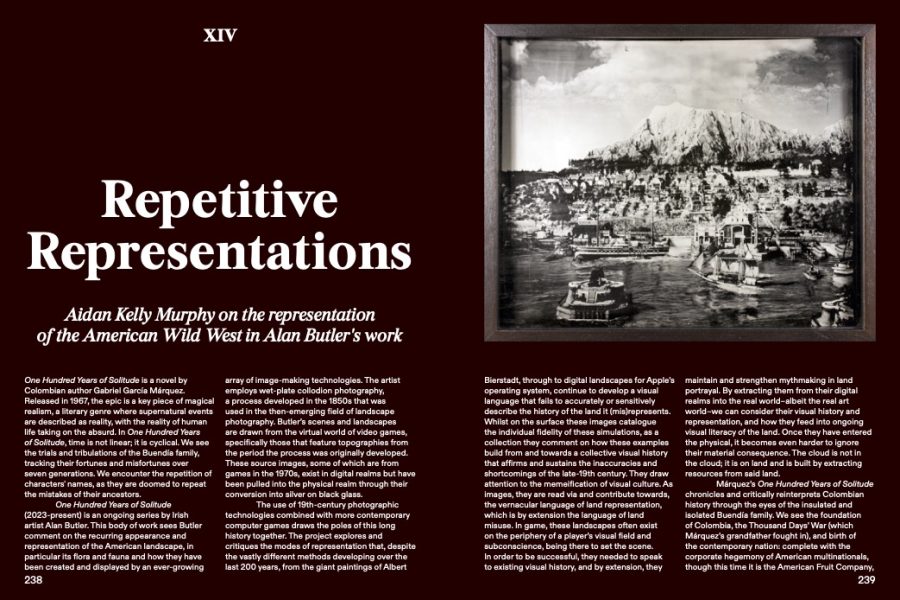
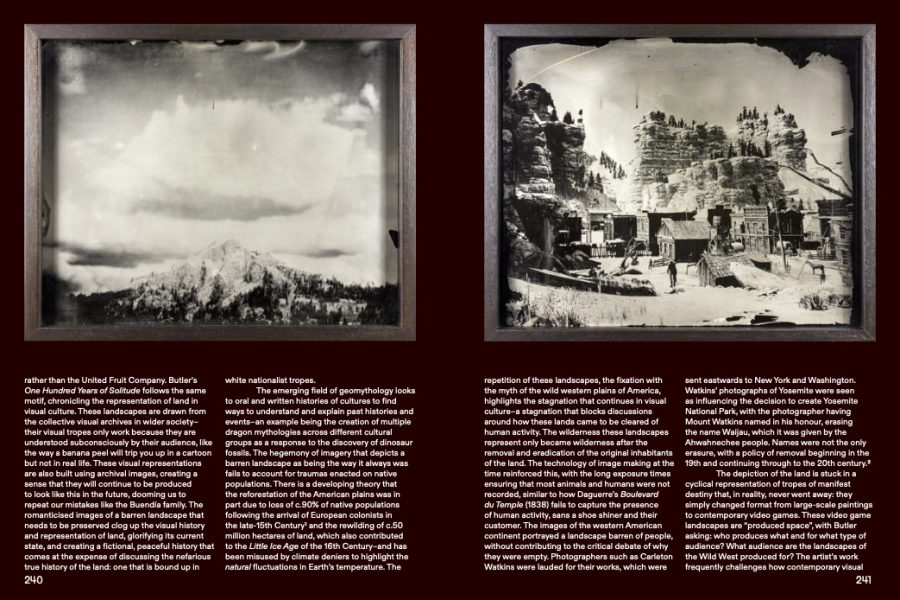
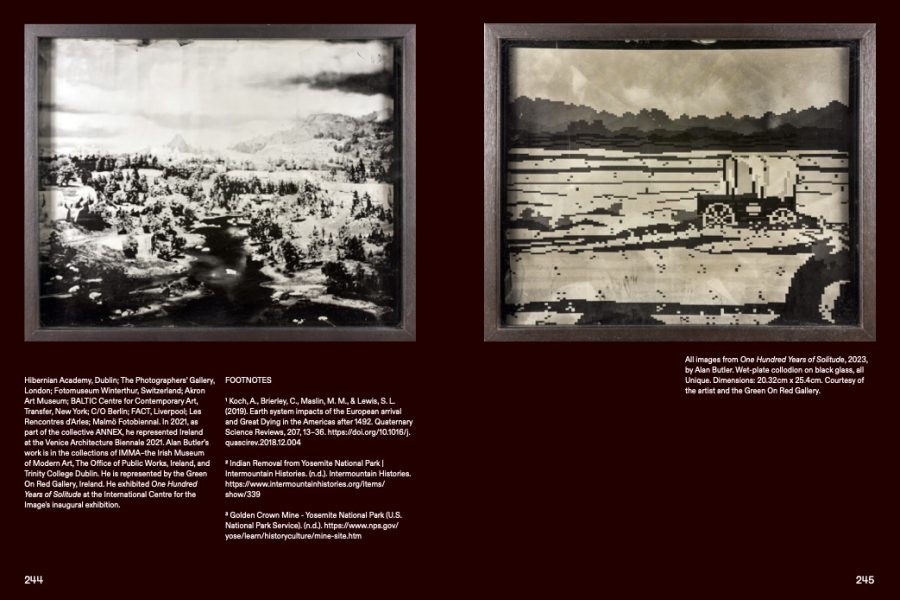
Aidan Kelly Murphy on Alan Butler’s ‘One Hundred Years of Solitude’ and the recurring presentation of the American Wild West, and its impacts on the history and representation of land in visual culture
***
‘One Hundred Years of Solitude’ is a novel by Colombian author Gabriel García Márquez. Released in 1967, the epic is a key piece of magical realism, a literary genre where supernatural events are described as reality, with the reality of human life taking on the absurd. In ‘One Hundred Years of Solitude’, time is not linear; it is cyclical. We see the trials and tribulations of the Buendía family, tracking their fortunes and misfortunes over seven generations. We encounter the repetition of characters’ names, as they are doomed to repeat the mistakes of their ancestors.
‘One Hundred Years of Solitude’ (2023-present) is an ongoing series by Irish artist Alan Butler. This body of work sees Butler comment on the recurring appearance and representation of the American landscape, in particular its flora and fauna and how they have been created and displayed by an ever-growing array of image-making technologies. The artist employs wet-plate collodion photography, a process developed in the 1850s that was used in the then-emerging field of landscape photography. Butler’s scenes and landscapes are drawn from the virtual world of video games, specifically those that feature topographies from the period the process was originally developed. These source images, some of which are from games in the 1970s, exist in digital realms but have been pulled into the physical realm through their conversion into silver on black glass.
The use of 19th-century photographic technologies combined with more contemporary computer games draws the poles of this long history together. The project explores and critiques the modes of representation that, despite the vastly different methods developing over the last 200 years, from the giant paintings of Albert Bierstadt, through to digital landscapes for Apple’s operating system, continue to develop a visual language that fails to accurately or sensitively describe the history of the land it (mis)represents. Whilst on the surface these images catalogue the individual fidelity of these simulations, as a collection they comment on how these examples build from and towards a collective visual history that affirms and sustains the inaccuracies and shortcomings of the late-19th century. They draw attention to the memeification of visual culture. As images, they are read via and contribute towards, the vernacular language of land representation, which is by extension the language of land misuse. In game, these landscapes often exist on the periphery of a player’s visual field and subconscience, being there to set the scene. In order to be successful, they needed to speak to existing visual history, and by extension, they maintain and strengthen mythmaking in land portrayal. By extracting them from their digital realms into the real world–albeit the real art world–we can consider their visual history and representation, and how they feed into ongoing visual literacy of the land. Once they have entered the physical, it becomes even harder to ignore their material consequence. The cloud is not in the cloud; it is on land and is built by extracting resources from said land.
Márquez’s ‘One Hundred Years of Solitude’ chronicles and critically reinterprets Colombian history through the eyes of the insulated and isolated Buendía family. We see the foundation of Colombia, the Thousand Days’ War (which Márquez’s grandfather fought in), and birth of the contemporary nation: complete with the corporate hegemony of American multinationals, though this time it is the American Fruit Company, rather than the United Fruit Company. Butler’s ‘One Hundred Years of Solitude’ follows the same motif, chronicling the representation of land in visual culture. These landscapes are drawn from the collective visual archives in wider society– their visual tropes only work because they are understood subconsciously by their audience, like the way a banana peel will trip you up in a cartoon but not in real life. These visual representations are also built using archival images, creating a sense that they will continue to be produced to look like this in the future, dooming us to repeat our mistakes like the Buendía family. The romanticised images of a barren landscape that needs to be preserved clog up the visual history and representation of land, glorifying its current state, and creating a fictional, peaceful history that comes at the expense of discussing the nefarious true history of the land: one that is bound up in white nationalist tropes.
The emerging field of geomythology looks to oral and written histories of cultures to find ways to understand and explain past histories and events–an example being the creation of multiple dragon mythologies across different cultural groups as a response to the discovery of dinosaur fossils. The hegemony of imagery that depicts a barren landscape as being the way it always was fails to account for traumas enacted on native populations. There is a developing theory that the reforestation of the American plains was in part due to loss of c.90% of native populations following the arrival of European colonists in the late-15th Century and the rewilding of c.50 million hectares of land, which also contributed to the ‘Little Ice Age’ of the 16th Century–and has been misused by climate deniers to highlight the ‘natural’ fluctuations in Earth’s temperature. The repetition of these landscapes, the fixation with the myth of the wild western plains of America, highlights the stagnation that continues in visual culture–a stagnation that blocks discussions around how these lands came to be cleared of human activity. The wilderness these landscapes represent only became wilderness after the removal and eradication of the original inhabitants of the land. The technology of image making at the time reinforced this, with the long exposure times ensuring that most animals and humans were not recorded, similar to how Daguerre’s ‘Boulevard du Temple’ (1838) fails to capture the presence of human activity, sans a shoe shiner and their customer. The images of the western American continent portrayed a landscape barren of people, without contributing to the critical debate of why they were empty. Photographers such as Carleton Watkins were lauded for their works, which were sent eastwards to New York and Washington. Watkins’ photographs of Yosemite were seen as influencing the decision to create Yosemite National Park, with the photographer having Mount Watkins named in his honour, erasing the name Waijau, which it was given by the Ahwahnechee people. Names were not the only erasure, with a policy of removal beginning in the 19th and continuing through to the 20th century.
about
Alan Butler works with traditional and new media as a means to explore subjects and ideas related to digital culture and their role in the formation of realities. With a production modality that utilises materials and media from the history of image-making, the body of work often examines how 3D graphics, video games and cloud technologies function both ideologically and politically.
His work has been exhibited at V&A Dundee, UK; transmediale/Akademie der Künste, Berlin; Royal Hibernian Academy, Dublin; The Photographers’ Gallery, London; Fotomuseum Winterthur, Switzerland; Akron Art Museum; BALTIC Centre for Contemporary Art, Transfer, New York; C/O Berlin; FACT, Liverpool; Les Rencontres d’Arles; Malmö Fotobiennal. In 2021, as part of the collective ANNEX, he represented Ireland at the Venice Architecture Biennale 2021. Alan Butler’s work is in the collections of IMMA – the Irish Museum of Modern Art, The Office of Public Works, Ireland, and Trinity College Dublin. He is represented by the Green On Red Gallery, Ireland.
Aidan Kelly Murphy is an artist and writer living in Dublin. He is co-editor of OVER Journal.
footnotes
- Koch, A., Brierley, C., Maslin, M. M., & Lewis, S. L. (2019). Earth system impacts of the European arrival and Great Dying in the Americas after 1492. Quaternary Science Reviews, 207, 13–36. https://doi.org/10.1016/j.quascirev.2018.12.004
- Indian Removal from Yosemite National Park | Intermountain Histories. (n.d.). Intermountain Histories. https://www.intermountainhistories.org/items/show/339