This text was originally published in Issue #4 of OVER Journal
Aidan Kelly Murphy discusses Liss Fenwick’s practice and their interrogation of the historical and ongoing impacts of extractive colonialist practices in Australia’s Northern Territory
***
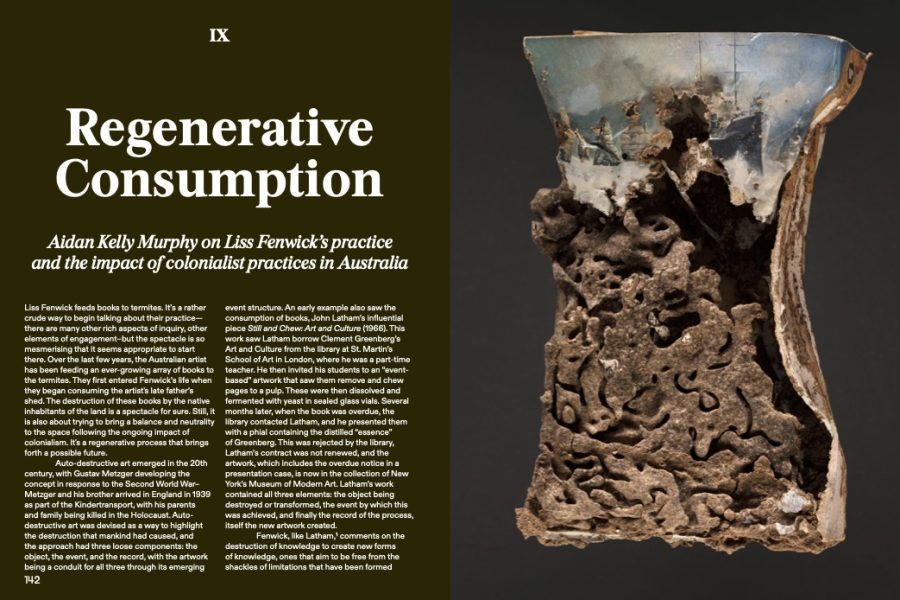
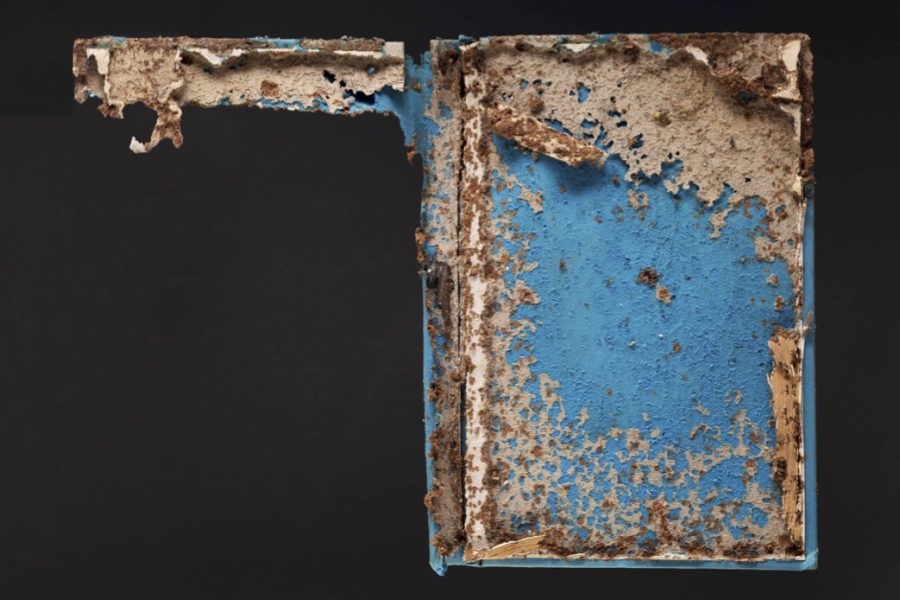
Liss Fenwick feeds books to termites. It’s a rather crude way to begin talking about their practice—there are many other rich aspects of inquiry, other elements of engagement–but the spectacle is so mesmerising that it seems appropriate to start there. Over the last few years, the Australian artist has been feeding an ever-growing array of books to the termites that first entered their life when they began consuming their late father’s shed. The destruction of these books by the native inhabitants of the land is a spectacle for sure. Still, it is also about trying to bring a balance and neutrality to the space following the ongoing impact of colonialism. It’s a regenerative process that brings forth a possible future.
Auto-destructive art emerged in the 20th century, with Gustav Metzger developing the concept in response to the Second World War–Metzger and his brother arrived in England in 1939 as part of the Kindertransport, with his parents and family being killed in the Holocaust. Auto-destructive art was devised as a way to highlight the destruction that mankind had caused, and the approach had three loose components: the object, the event, and the record, with the artwork being a conduit for all three through its emerging event structure. An early example also saw the consumption of books, John Latham’s influential piece ‘Still and Chew: Art and Culture’ (1966). This work saw Latham borrow Clement Greenberg’s Art and Culture from the library at St. Martin’s School of Art in London, where he was a part-time teacher. He then invited his students to an ‘event-based’ artwork that saw them remove and chew pages to a pulp. These were then dissolved and fermented with yeast in sealed glass vials. Several months later, when the book was overdue, the library contacted Latham, and he presented them with a phial containing the distilled ‘essence’ of Greenberg. This was rejected by the library, Latham’s contract was not renewed, and the artwork, which includes the overdue notice in a presentation case, is now in the collection of New York’s Museum of Modern Art. Latham’s work contained all three elements: the object being destroyed or transformed, the event by which this was achieved, and finally the record of the process, itself the new artwork created.
Fenwick, like Latham1, comments on the destruction of knowledge to create new forms of knowledge, ones that aim to be free from the shackles of limitations that have been formed by colonial thought. The work is rooted in the Northern Territory, addressing local histories and commenting on the extractive settler colonialism that the area has, and continues to feel. This sees the artist metaphorically reverse the devastation inflicted on Indigenous communities, and the flora and fauna they have cared for; directing it at the literature used to justify these behaviours, looking to remove not just these pieces of literature, but the ideas, the phantasms of colonialism that continue to promote extractive settler colonialism.
When talking about books from the Northern Territory being eaten, the conversation will, eventually, see mentions of Borroloola and its library. The town in Australia’s Northern Territory is 1,000 miles from Darwin and 70 miles from McArthur River mine (one of the world’s largest zinc-lead-silver mines), and provides a microcosm for colonialism in wider Australia and the empire at large. Borroloola, established in the late-19th century on unceded Yanyuwa land, is rich in myths and legends–legends that romanticise colonial destruction at the expense of First Nations and their culture. In 1888 a Cornelius Power, who was born in Cork but had emigrated to Australia at 22, was sent to the recently incorporated town. The tale goes that Power, tired of waiting months on end for news, and bored with not having anything to read, decided to establish a library in the town2. Some debate, at this stage unresolvable, persists over whether Power established the library with help from a Carnegie scheme or through local government–a fellow Corkonian, Redmond Barry, who famously tried and sentenced Ned Kelly, had founded the State Library of Victoria in 1854.
Regardless of where the books came from, Power received thousands, and so began the Borroloola library, which was housed in the local courthouse, further adding to the analogy of colonial knowledge being welded as power and force. It was established at a time of increased social interest in these institutions, in no small part due to Andrew Carnegie’s scheme of building 2,509 libraries globally. These buildings were more than just repositories of books; they were symbols of civic pride and development. In the far-flung corners of the empire–and there were few places more far-flung than the Northern Territory–they represented the bringing of knowledge and civilisation to distant lands. Your town was a proper town when it had a library. Libraries represent a centralisation of information and knowledge, and their ability to provide access to these knowledge systems is, and should remain, a commendable ideal. Libraries are a somewhat funny concept. It would be hard, and somewhat dangerous, to criticise them in an age of decreasing reading3 and increasing disinformation. Their murkiness exists and persists when the editing and selecting of what knowledge systems should be preserved are prioritised over others.
It isn’t the establishment of the library by Power, who died in 1904, but what happened after it that saw this library enter popular culture. By the 1920s, the 3,000 books within the library had fallen into poor condition–the local climate and building that they were housed in hastened their deterioration. Up stepped a Mrs Jack Kelly who, by hand, rebounded each and every book4. These efforts were in stark contrast to the loss of knowledge that was happening concurrently in the Northern Territory, with dozens of First Nations languages being lost at a time5 when these reproducible bastions of Western knowledge were being painstakingly preserved. The attempts by Mrs Kelly to preserve these books were ultimately futile, as by 1963, when a young David Attenborough visited Borroloola6, the library’s contents were in ruins, being consumed by ‘White Ants’.
The name ‘White Ants’ is misleading; they are in fact termites–and rare termites at that. Of the ten genera identified for the Mastotermitidae, only the Mastotermes Darwiniensis (also known as the giant northern termite or Darwin termite) remains. This is the same species Fenwick now feeds settler fanfiction and other types of literature that fail to understand the land they seek to inhabit. Many of the books were brought to the Northern Territory by those looking to, and whether they knew it or not is besides the point, exploit it. This process has, to date, seen a number of outputs including: ‘The colony cares for everyone’ (2021-present), ‘Body of Knowledge’ (2021-present) and ‘COLONY’ (2025).
‘The colony cares for everyone’ comments on the impact of mining activities in the Northern Territory, making use of still and moving images. In the latter, we see shots of termite mounds with mining activity behind, these are interlaced with close-ups of the termites chewing through books, and as viewers, we hear the converging sounds of mining and chewing, drilling and crawling. The mine, on unceded Larrakia Land, is the Finniss Lithium mine, which began commercial production in 2023 and is expected to see 16 million tonnes of lithium extracted7. These termite mounds are scanned for the presence of lithium, and if found, are earmarked for destruction. Fenwick’s choice of materials (settler fanfiction and histories), companions (the Mastotermes Darwinensis), and locations (the artist created a site-specific installation in the Former Magistrates’ Court building in Melbourne, where Barry convicted Kelly) tethers the work to Australia. In addressing the localised, a universal approach can be identified for its audience. The resources that are to be gathered, which are all to be exported, are for the ‘clean energy transition’ and for goods that will be sold globally. The artist highlights how these types of narratives are, and have been used for centuries, as a justification for ecosystem destruction to bring about a more ‘prosperous future’–a future that is often centred around maintaining existing levels of consumer capitalism at the expense of vulnerable habitats and communities.
Concerns exist over the potential expansion of the Finniss Lithium mine and its impact on the local environment. The site is not far from the infamous Rum Jungle uranium mine pit, which supplied uranium to the British and American armies during the Cold War and left in its wake an ecological disaster which the commission established to investigate it in 1977 said “represents to many people, not least of all the Aboriginal people, an awful example of what should not be allowed to happen”8.
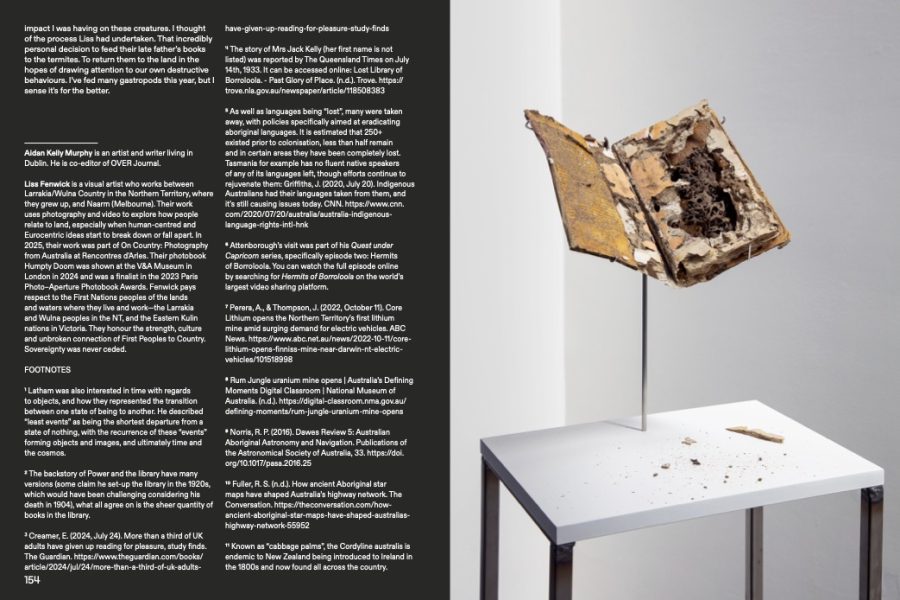
If ‘The colony cares for everyone’ is the event component of Auto-destructive art, then the ‘Body of Knowledge’ is its object and record. In this, we see the structures formed by the termites, and they are mesmerising to look at. They leave behind tunnels, the parts of the book not consumed, never-ending maps of their conversion of paper into energy to bring back to their nests. The pathways through the books evoke thoughts of songlines (also called dreaming tracks), which were, and continued to be, used as navigational tools by Aboriginal people, with the songs outlining routes that travellers needed to use to navigate local terrains. For example, the Yolngu people, situated in modern-day Arnhem Land in the Northern Territory, tell of Barnumbirr, their creator-being, who guided the first humans to Australia and then flew over the Northern Territory naming the local flora and fauna9. These oral maps were passed down from generation to generation, with some songlines spanning the languages of different First Nations. These oral maps were then utilised by colonisers, through local guides10, during exploration and ultimately in the creation of the contemporary highways which now bring settlers and miners to the Northern Territory to extract resources. By utilising a native species to consume the knowledge of colonialism, Fenwick highlights the need to not just recognise native ownership of the land, but also incorporate their stewardship and care for it. Drawing attention to past knowledge systems that have been lost or usurped by external actors, and proposing a future that recognises and incorporates them. Whilst the artist’s work can be framed within the concepts of auto-destructive art, destruction is not the focus of the work but a by-product. The termites are co-collaborators, positioning Fenwick as a facilitator of their activity. They don’t destroy the books per se; instead, they transform and convert the materials into energy and sustenance, leading to a regeneration of their colony through the dismantling of knowledge systems that support extractive settler colonialism.
Fenwick’s images are of sculptures, as well as being sculptures themselves, which can be seen through the display of the work in exhibitions. In ‘COLONY’, we encounter the cyclical properties of this aspect of the artist’s practice, with the images of the consumed books being turned into a book itself and then presented as a sculptural object. And whilst the work has developed into these other mediums, they remain at their core images. They comment on the indexical quality of photography, rooting it in Humpty Doo (Larrakia/Wulna Land) in Australia’s Northern Territory. This inherently local quality highlights the opportunities available to us to enact change–that old chestnut of changing the world by changing your street corner. As I view the work, I am reminded of the distance from me to Liss. The distance that the likes of Cornelius Power and Redmond Barry travelled, and how both time and space can be compressed by photography. In the last few months, I have found myself frequently thinking of the termites eating settler fanfiction whilst pottering around my garden. For the last seven years, I have been locked in a cyclical battle with slugs and snails every Spring and Summer. The previous owners of our house decided to concrete every inch of the property–sans two bricked-in cabbage palms11–meaning that the only available food for them is whatever I place into our garden in pots. I became territorial in my approach, and having lost countless lettuce, strawberries, and flowers over the years, I decided to place copper around my pots to deter them. However, I was conscious of the source of this copper and the impact I was having on these creatures. I thought of the process Liss had undertaken. That incredibly personal decision to feed their late father’s books to the termites. To return them to the land in the hopes of drawing attention to our own destructive behaviours. I’ve fed many gastropods this year, but I sense it’s for the better.
about
Liss Fenwick is a visual artist based on Larrakia land in the Northern Territory, where they were born and raised, and Naarm (Melbourne). They work with visual languages to explore speculative outcomes of failing human-centeredness and Eurocentrism. They are undertaking a PhD at RMIT University, Melbourne and were awarded the prestigious Macquarie Group Emerging Artist Prize in 2018.
Aidan Kelly Murphy is an artist and writer living in Dublin. He is co-editor of OVER Journal.
- Latham was also interested in time with regards to objects, and how they represented the transition between one state of being to another. He described ‘least events’ as being the shortest departure from a state of nothing, with the recurrence of these ‘events’ forming objects and images, and ultimately time and the cosmos.
↩︎ - The backstory of Power and the library have many versions (some claim he set-up the library in the 1920s, which would have been challenging considering his death in 1904), what all agree on is the sheer quantity of books in the library.
↩︎ - Creamer, E. (2024, July 24). More than a third of UK adults have given up reading for pleasure, study finds. The Guardian. https://www.theguardian.com/books/article/2024/jul/24/more-than-a-third-of-uk-adults-have-given-up-reading-for-pleasure-study-finds
↩︎ - The story of Mrs Jack Kelly (her first name is not listed) was reported by The Queensland Times on July 14th, 1933. It can be accessed online: Lost Library of Borroloola. – Past Glory of Place. (n.d.). Trove. https://trove.nla.gov.au/newspaper/article/118508383
↩︎ - As well as languages being ‘lost’, many were taken away, with policies specifically aimed at eradicating aboriginal languages. It is estimated that 250+ existed prior to colonisation, less than half remain and in certain areas they have been completely lost. Tasmania for example has no fluent native speakers of any of its languages left, though efforts continue to rejuvenate them: Griffiths, J. (2020, July 20). Indigenous Australians had their languages taken from them, and it’s still causing issues today. CNN. https://www.cnn.com/2020/07/20/australia/australia-indigenous-language-rights-intl-hnk
↩︎ - Attenborough’s visit was part of his ‘Quest under Capricorn’ series, specifically episode two: Hermits of Borroloola. You can watch the full episode online by searching for ‘Hermits of Borroloola’ on the world’s largest video sharing platform.
↩︎ - Perera, A., & Thompson, J. (2022, October 11). Core Lithium opens the Northern Territory’s first lithium mine amid surging demand for electric vehicles. ABC News. https://www.abc.net.au/news/2022-10-11/core-lithium-opens-finniss-mine-near-darwin-nt-electric-vehicles/101518998
↩︎ - Rum Jungle uranium mine opens | Australia’s Defining Moments Digital Classroom | National Museum of Australia. (n.d.). https://digital-classroom.nma.gov.au/defining-moments/rum-jungle-uranium-mine-opens
↩︎ - Norris, R. P. (2016). Dawes Review 5: Australian Aboriginal Astronomy and Navigation. Publications of the Astronomical Society of Australia, 33. https://doi.org/10.1017/pasa.2016.25
↩︎ - Fuller, R. S. (n.d.). How ancient Aboriginal star maps have shaped Australia’s highway network. The Conversation. https://theconversation.com/how-ancient-aboriginal-star-maps-have-shaped-australias-highway-network-55952
↩︎ - Known as ‘cabbage palms’, the Cordyline australis is endemic to New Zealand being introduced to Ireland in the 1800s and now found all across the country
↩︎